The handover from approved sample to bulk is where a refillable programme either holds together or quietly changes. The scent is only one of the variables: fill level, closure torque, pump dose, pack weight and the colour of the decoration can all move between the bench and the line. For a retailer's own brand the risk is higher than for most, because the retailer has promised a specification to stores and has no development team standing between the factory and the shelf. Holding the handover means comparing the right things at the right moment, in writing.
Key takeaways
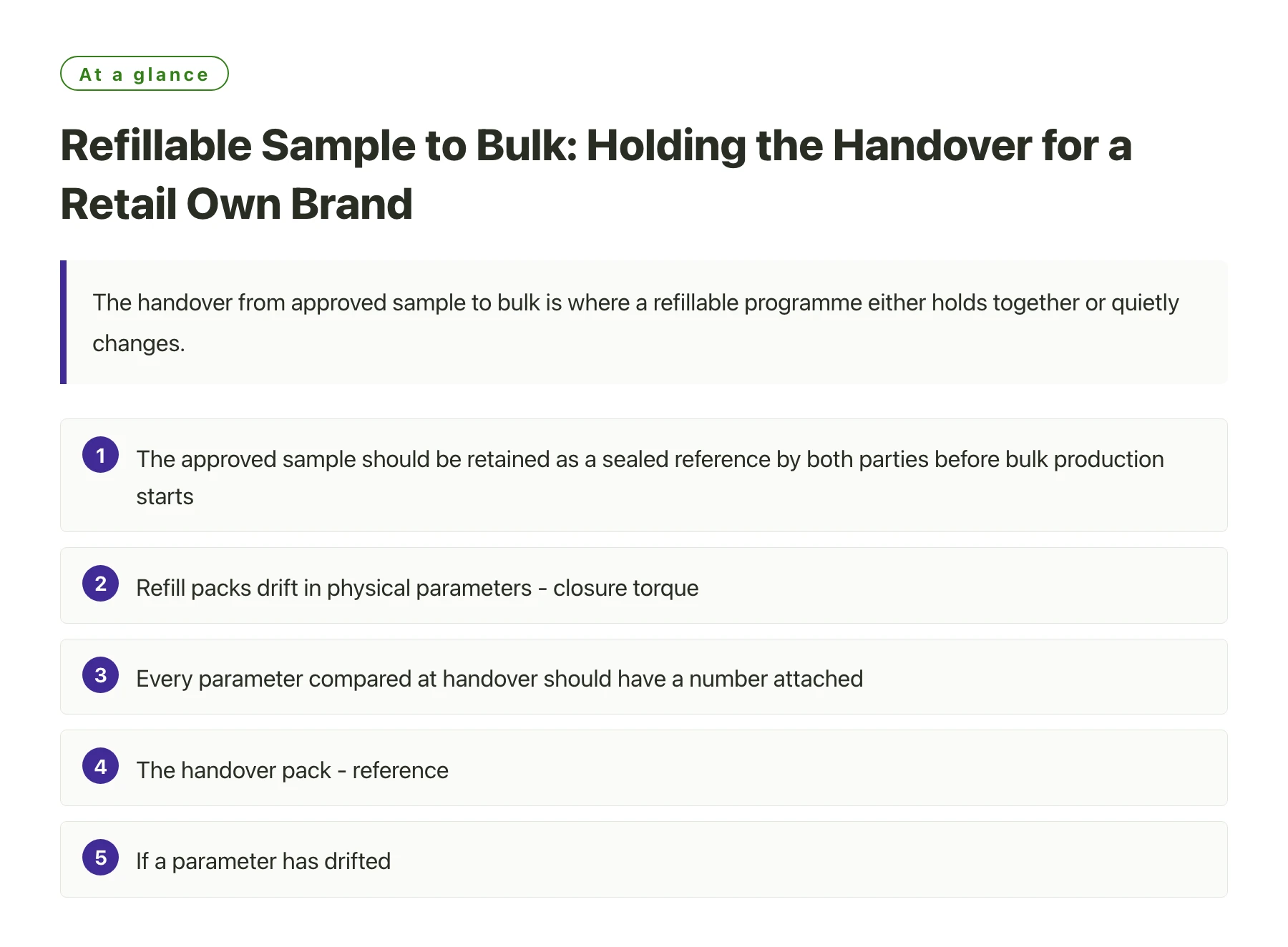
- The approved sample should be retained as a sealed reference by both parties before bulk production starts, not after.
- Refill packs drift in physical parameters - closure torque, pump dose and fill level - more often than they drift in scent.
- Every parameter compared at handover should have a number attached, because a description cannot be measured at bulk.
- The handover pack - reference, specification, batch record, artwork and tooling list - is the document set that makes a reorder routine.
- If a parameter has drifted, the decision to accept, rework or retest belongs to the retailer, and it should be recorded even when the batch is accepted.
Sample approval feels like the end of development. Structurally it is the middle: the sample sets the target, and bulk production is the first attempt to hit that target at scale in the real pack.
This article looks at the seam between the two, with particular attention to refillable formats, where the pack carries as much risk as the liquid.
The handover is a seam, and seams leak
A development bench can afford to be careful in ways a filling line cannot. The bench can weigh by hand, adjust a closure until it feels right and check every unit. A line works to a target with a tolerance, and the tolerance is what the retailer actually buys.
That is why the handover is not a moment of approval but a comparison. The sample defines the target; the bulk demonstrates whether production can reach it repeatedly. Retailers that treat bulk approval as a formality tend to discover the difference in stores, where the failure is visible to shoppers and expensive to correct.
Public process material is a useful starting point for understanding the sequence - the process descriptions published at www.xuelei.com/, for example, set out compounding, resting, filling and packing - but a sequence is not an acceptance criterion. The criteria have to come from the retailer's own specification and from the parameters agreed at sample approval.
What drifts between sample and bulk
| Parameter | Fixed at sample stage | How it drifts at bulk | How to hold it |
|---|---|---|---|
| Odour and colour of the liquid | Against the selected reference, in a defined container | Slight shift from material lot change or resting time | Retain a sealed bulk reference and compare under the same conditions |
| Fill level | Visual and by weight on a hand-filled unit | Line fillers run to a tolerance band, and the band is wider than the bench unit | Agree the tolerance in millilitres and check against it, not against the sample alone |
| Closure torque or crimp | Set by feel on a small number of units | Machine setting drifts with component lots, especially on threaded refill closures | Specify a torque range and a leak test, and record both per batch |
| Pump or spray dose | Measured on a few sample packs | Actuator and dip tube variation moves the dose between component lots | Agree a dose range and a test method with a defined number of actuations |
| Decoration colour and position | Approved from a proof or a single decorated unit | Print and label position shift with line speed and substrate | First-article approval plus a measured position check during the run |
| Pack weight and material | Recorded informally during sampling | Component substitution or a supplier change alters it silently | Write the component into the specification and require notice of any substitution [1] |
The pattern is consistent: chemistry is usually well controlled, while mechanical and physical parameters are where refill packs lose consistency.
The handover pack: six items to close before bulk ships
- The sealed referenceTwo sealed, dated reference units - one held by the retailer, one by the factory - taken from the approved sample production.
- The versioned specificationA single current revision with numeric tolerances for fill, dose, torque and colour, plus a change log showing what moved and when.
- The batch recordCompounding, resting, filling and in-process checks, with the sample size and the action taken on any failure.
- The decoration approvalFirst-article sign-off with a measured position and colour result, not a photograph alone.
- The tooling and component listA named list of moulds, plates and components, including who owns each one, so that a factory that handles fragrance R&D and production can be held to the same pack on reorder.
- The reorder parametersLead time, minimum reorder quantity, price at the top and bottom of the volume band, and the notice period for any material change.
Where refill formats behave differently
The general rules above apply to any fragrance order. Refill formats add three specific risks that deserve their own line in the handover.
Compatibility is a production parameter, not a design idea
A refill closure that works on a bench-tested unit may behave differently on a production component lot. The handover should include a compatibility check on units taken from the actual production run, covering leakage after repeated opening, priming behaviour and dose consistency. Where the refill mechanism depends on a pump, asking the manufacturer to confirm restriction compliance for the fragrance that sits behind it is part of the same conversation [2].
It also helps to walk the whole chain once, from formula to finished bottle, and mark the points where the refill changes the process. A walkthrough such as Xuelei makes those points visible, and visible points are the ones that get checked.
Decoration and pack weight move together
A refill programme usually presents itself as lighter packaging, which means pack weight is part of the claim. If the decoration method or the component supplier changes between sample and bulk, the weight changes with it, and the claim on the pack may no longer be accurate. Recording the weighed pack at handover protects the claim as well as the product.
The presentation standard matters more when the line is positioned at the upper end. premium fragrance production partner work often involves tighter colour and finish targets, and those tolerances should be agreed at the same time as the functional ones rather than discovered at first article.
In every case, the acceptance decision belongs to the retailer. If a parameter has drifted outside the agreed range, whether the batch is accepted, reworked or retested is a commercial decision with a brand consequence, and it should be minuted even when the answer is to accept.
The handover is complete when a third party could take the file, order the same refill pack from a different supplier and reproduce the same result. If that is not possible, the file is a set of notes rather than a specification.
Sources
- Chemistry World (Royal Society of Chemistry) —— The Royal Society of Chemistry's magazine, covering chemistry research and explanations of everyday materials including aroma compounds.
- IFRA: Safe Use and Fragrance Science —— IFRA's explanation of how fragrance materials are scientifically assessed for safe use and how those conclusions are applied by the industry.
Frequently asked questions
What should be compared between an approved sample and a bulk run?
Liquid odour and colour under the same conditions, fill level by weight, closure torque or crimp, pump dose, decoration position and colour, and pack weight. The mechanical parameters matter most for refillable packs, because they are the ones that shift between bench and line.
Who keeps the reference sample?
Both parties, sealed and dated at the same time. The retailer needs an independent reference to settle complaints; the factory needs a working reference to set up production. A single retained sample held only by the supplier is not enough for an own-brand programme.
How do we handle a batch that drifts slightly outside the agreed range?
Decide against the specification, not against the sample. If the deviation is inside the tolerance, record it and release. If it is outside, ask for the cause and the corrective action before deciding whether to rework, retest or accept with a documented rationale.
Does the handover change for a refill pack with a printed claim?
Yes, in one respect: pack weight and material become part of the claim, so any substitution of a component or a decoration method has to be notified and re-checked. That check belongs in the same handover pack as the functional tests.
What makes a reorder easier?
A versioned specification, a named component and tooling list, agreed reorder quantities and lead times, and a reference sample that both parties still hold. With those four items, a reorder is largely administrative; without them, it is a small development project.