A plywood supplier meets different market requirements by changing panel construction, dimensions, bonding, surface grade, emissions, certification, packaging, and documentation around the buyer’s end use. A European furniture producer may need 18 mm calibrated plywood with tight thickness control and FSC® documentation, while a formwork distributor may order 12–21 mm phenolic-faced panels with sealed edges and moisture-resistant bonding. Since plywood under CN 4412 falls within the EU Deforestation Regulation’s wood-product scope, supply records also matter. From 30 December 2026, EUDR obligations apply to large and medium operators, with different timing for qualifying micro and small operators.
The process starts with the application, because two panels sold as “18 mm plywood” may perform very differently. Furniture production usually places more attention on thickness calibration, flatness, face quality, machining, screw holding and emissions; construction buyers are more concerned with bond durability, panel strength, edge protection and repeated handling. A supplier producing for several European markets may therefore work with 4 mm, 6 mm, 9 mm, 12 mm, 15 mm, 18 mm, 21 mm and 25 mm thicknesses rather than treating 18 mm as a universal specification.
Dimensions need the same treatment. 1220 × 2440 mm remains common in international trade, while 1250 × 2500 mm fits many European distribution channels; 1500 × 3000 mm and cut-to-size formats are used where fewer joints or less factory cutting is preferred. If a furniture factory cuts 5,000 sheets each month, even a small dimensional mismatch can add repeated trimming and material loss, so the purchase specification should state nominal dimensions, permitted tolerance and squareness rather than listing size alone.
Thickness is especially important once panels enter CNC routing, drilling, laminating or automated assembly. A nominal 18 mm board that varies noticeably through a batch can change groove fit, fastener depth and laminated-panel alignment. Suppliers serving industrial users therefore calibrate and sand panels according to agreed tolerances, then measure several points across each sampled sheet instead of checking only one edge. The accepted tolerance should be written into the order before mass production, because furniture, flooring and general building applications do not need identical limits.
Internal construction comes next. Poplar can reduce panel weight, eucalyptus and other hardwood veneers can increase density, and birch is often chosen where machining quality, strength and a uniform layered edge are wanted. Mixed constructions can balance weight, mechanical properties and price. The species name, however, does not describe veneer quality: an 18 mm panel can contain very different veneer thicknesses, gaps, overlaps and repairs even when both invoices use the same species description.
For that reason, buyers should define the lay-up as well as the wood species. Useful checks include veneer count, average veneer thickness, repaired defects, open core gaps and face-to-core bonding. A factory processing several thousand panels per month may set an incoming inspection sample rather than opening every package; the supplier can use the same sampling plan before shipment so both sides judge the product against comparable measurements.
Moisture control connects veneer preparation with later dimensional stability. Veneers that enter gluing at unsuitable moisture levels can contribute to poor bonding, local deformation or panel movement after delivery. Finished plywood used indoors is commonly supplied within a controlled moisture range agreed between producer and buyer; the acceptable number should be written into the technical sheet instead of relying on terms such as “dry plywood.” In a shipment of 10,000 sheets, even a 2% rejection rate represents 200 panels that need sorting, replacement or secondary use.
Adhesive selection then has to match the service environment. Interior furniture plywood, humid-condition panels and concrete formwork do not face the same exposure. Suppliers may use different resin systems depending on the required bond class, emission target and product specification, but trade expressions such as “waterproof” should not replace a defined test standard. Buyers comparing quotations should ask which bonding requirement is being supplied and how production lots are checked.
Formaldehyde requirements also differ by destination and use. An indoor cabinet component is evaluated differently from temporary construction sheathing, and labels such as E1 should be connected to the test method stated in the contract. European panel specifications have long used formaldehyde classes and standardized test procedures, while manufacturers serving regulated markets often keep current laboratory reports for the exact product construction being purchased rather than presenting one report from 2019 for every plywood range.
Surface requirements introduce another set of variables. A visible birch-faced cabinet panel may require controlled veneer color, patches, sanding and face grade, while a plywood substrate that will receive HPL or another finish can use a less decorative face if the surface remains flat and well sanded. Paying for an appearance grade that disappears under laminate raises material cost without improving the finished furniture, so surface selection should follow the production route.
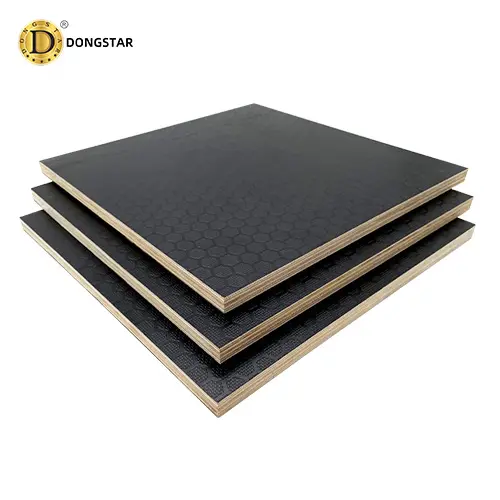
Construction buyers usually move in the opposite direction: face appearance matters less than coating, bonding and edge condition. Film Faced Plywood commonly uses resin-impregnated film over the plywood surface for concrete formwork and related applications. Buyers may specify 12 mm, 15 mm, 18 mm or 21 mm panels, film weight, panel density, edge sealing and adhesive system. Reuse counts should be treated as site-dependent figures because cutting, release agents, concrete chemistry, cleaning, storage and exposed edges all affect service life.
A quotation therefore becomes easier to compare when it uses measurable fields rather than product names alone:
| Purchase item | Typical information to specify | Why buyers record it |
|---|---|---|
| Panel size | 1220 × 2440 or 1250 × 2500 mm | Cutting plan and warehouse fit |
| Thickness | 9–25 mm plus tolerance | Machining and assembly |
| Construction | Poplar, hardwood, birch or mixed | Weight and mechanical properties |
| Surface | Natural veneer, film or prepared substrate | Final use and finishing |
| Bonding | Requirement matched to service condition | Moisture exposure |
| Moisture | Agreed production range | Stability and processing |
| Documentation | FSC®, DoP, CE-related documents where applicable | Customer and market requirements |
The paperwork becomes more important when plywood enters the European market. Regulation (EU) 2023/1115 includes plywood, veneered panels and similar laminated wood under CN 4412. Under the current timetable, the main EUDR obligations apply from 30 December 2026 to large and medium operators and from 30 June 2027 to many qualifying micro and small operators; some smaller operators already covered by the former EUTR follow the 30 December 2026 date.
EUDR preparation is therefore connected to timber origin records, product identification and supply-chain information rather than to panel appearance. An exporter selling the same 18 mm plywood into several countries may need to provide commercial documents that allow the European operator to connect the shipment with the information required for due diligence. Plywood is explicitly listed in the regulation under CN 4412, so importers should confirm the applicable obligations and dates for their company size and role.
FSC® orders add a separate traceability requirement. FSC states that Chain of Custody certification covers the sourcing, processing, labelling and sale of forest-based products, and certified material has to remain identifiable and traceable through the supply chain. Certification bodies conduct third-party assessments, and FSC describes annual surveillance audits with certificates valid for 5 years. A buyer ordering FSC-certified plywood should therefore check the claim on the sales documents rather than assuming that a factory certificate automatically makes every panel FSC-certified.
Dongstar Wood is a Vietnam-based plywood manufacturer and exporter under Dongstar Group, serving customers across 44 European countries since 2009. We specialize in commercial plywood, film faced plywood, construction plywood, birch plywood, furniture plywood, and customized plywood solutions.
Backed by CE 2+, FSC®, EUDR, DOP, and SEDEX (BSCI) certifications, we meet European standards for quality, sustainability, and compliance. With over 15 years of manufacturing and export experience, we support importers, distributors, furniture manufacturers, and construction companies with reliable plywood supply and OEM/ODM solutions.
Production control has to match the documents. A useful inspection plan follows material from veneer preparation through lay-up, pressing, conditioning, sanding, sizing and packing. Rather than checking only finished appearance, inspectors can record thickness at several positions, dimensions, moisture, face defects, edge condition, delamination signs and package identification. For an order of 8,000 sheets produced across several batches, retaining lot numbers allows a complaint to be narrowed to a production period instead of treating the whole shipment as identical.
Approved samples also need limits. A sample selected from 10 panels can show color, construction and finish, but it cannot guarantee the appearance of thousands of natural-wood sheets unless the acceptable grade is written down. A useful approval file combines the physical sample with dimensions, tolerance, core construction, face grade, bonding requirement, moisture specification, packing method and test documents. Mass production can then be checked against recorded criteria rather than memory.
Packaging follows the same product-specific approach. Export bundles may use protective panels, moisture barriers, corner protection, PET or steel strapping, pallets and printed marks according to the route and unloading method. A distributor handling 20 containers per month may need package labels showing SKU, dimensions, quantity, batch and purchase-order number, while a furniture plant may prefer bundles arranged around its daily cutting schedule.
Container planning combines volume with weight. Increasing sheet count is useful only while gross container weight, handling limits and local transport rules remain acceptable. Panel density, thickness, package height and pallet weight should therefore be calculated before loading. If an 18 mm construction panel is materially denser than a lightweight furniture panel, two containers with the same internal volume may reach their practical weight limits at different sheet counts.
Commercial flexibility finishes the supply model. A distributor may want 5 or 6 specifications for stock, while an industrial furniture producer may repeatedly order one calibrated panel with fixed tolerances and labeling. OEM/ODM orders can add special dimensions, face veneer, film, printed marks, package design or cut-to-size processing. Suppliers serving both groups need specifications, production records and shipment documents that remain consistent from the first approved sample through repeat orders in 2026 and later.