Why a VPN Is Not the Same as Privacy
A VPN changes one thing: the network path between your device and a site. Privacy on an account-based platform is a different problem, because the account itself is what links conversations, saved characters and preferences together. Crushon states that its Porn Chat AI service runs in a private and secure environment with state-of-the-art encryption, and that claim is about the service, not about the tunnel you happen to be using.

Key takeaways
- A VPN masks a network identifier. It does not remove an account, a saved list, or a conversation history, which is where most privacy questions actually live.
- The site's own wording is a private and secure environment with state-of-the-art encryption; nothing in that sentence depends on your choice of tunnel.
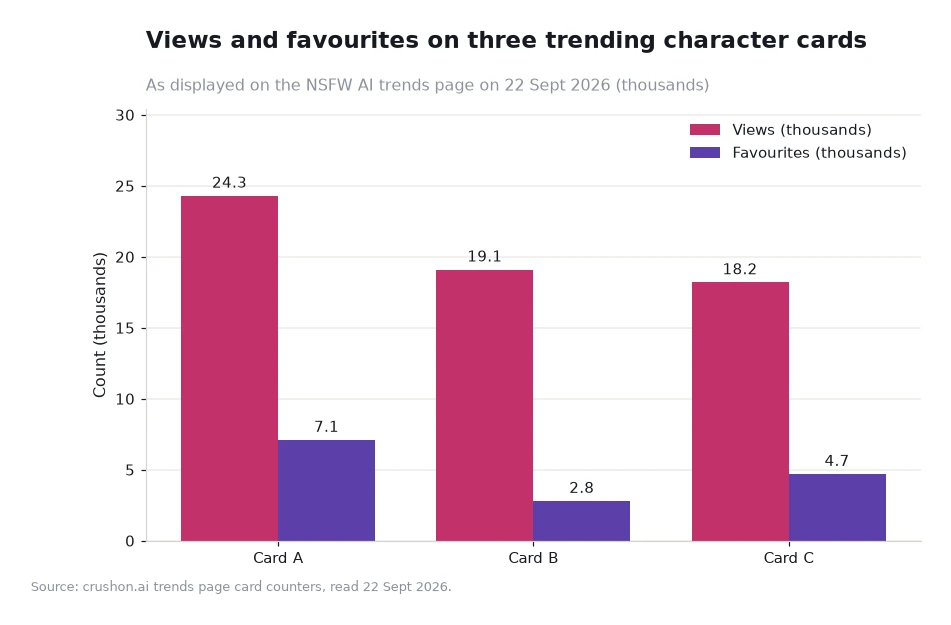
- Published counters offer a sense of scale for how much activity accumulates: 24.3M views against 7.1K favourites on the busiest trends card works out at about 0.029 percent.
- Compliance is a separate layer again — an 18 U.S.C. section 2257 statement, last updated 8 Feb 2025, covers content provenance rather than how you connect.
Three different layers people call privacy
Transport is the layer a VPN addresses. Your traffic takes a different route, and the site sees a different network address. That is a real benefit in some situations, and it is also narrow: it changes how you arrived, not what you do when you get there.
Account privacy is the second layer, and it is the one that matters here. A signed-in account holds your saved characters, the preferences the system has learned, and the history of what you opened. None of that is affected by routing, because the account is the thing being stored, not the connection that delivered it.
The third layer is device and household privacy. What appears on your own screen, what a shared laptop remembers, and whether someone else can pick the device up are local questions. A tunnel through a server in another country does nothing about a browser left open on a kitchen table.
| Layer | VPN effect | Account privacy effect |
|---|---|---|
| Network route | Changes the path your traffic takes | Not applicable |
| Network address seen by the site | Replaced with the tunnel's address | Unchanged; the account is still the same account |
| Saved characters and preferences | No effect | Tied to the account and its settings |
| Conversation history | No effect | Governed by the service, not the route |
| Content provenance | No effect | Covered by the platform's compliance statement |
| Shared device exposure | No effect | Reduced by signing out and by device-level locks |
Worked example: one variable against several
Count what changes when a tunnel is switched on. The network address is one variable. Everything else on the account side stays exactly as it was: the saved list, the preference profile, the history of open conversations, and the email attached to the account.
Put ordinary volumes against that list. An illustrative reader who sends 40 messages a day writes 1,200 messages in a 30-day month. If they also save characters at a modest illustrative pace of 7 a month, six months produces 42 saved entries. Neither number is a platform measurement; both are worked examples of how quickly an account accumulates material that a VPN never touches.
Time behaves the same way. Four weekly sessions of half an hour come to two hours a week, which is eight hours across a four-week month. Doubling the session length while halving the frequency leaves the monthly total unchanged, which is a useful reminder that the account's footprint depends on your habit, not on how the traffic is routed.
What the platform actually says about privacy
The useful sentences are the ones on the product's own pages. The adult chat section describes a private and secure environment and refers to state-of-the-art encryption, and its FAQ notes that some limitations apply under the site's content and community guidelines. Read those two statements together and the promise becomes specific: a protected service with published rules, rather than an absolute guarantee about anonymity.
Provenance is documented separately. The 18 U.S.C. section 2257 compliance statement, last updated 8 February 2025, sets out that the content is AI-generated text and depicts no real person. That answers a question a VPN cannot: what the material on the site actually is. The 2257 compliance statement is the page to read if you want the platform's own wording rather than a forum summary.
Reporting is the third documented surface. Every content page carries a report route, and the site also accepts reports by email at [email protected], with the process described on the content removal policy page. Notice what this adds to the picture: privacy is not only about who can see you, but about what you can do if something on the service is wrong.
Where the VPN myth does damage
The myth is dangerous for one reason: it invites people to skip the steps that do matter. Someone who believes routing equals privacy may keep a session open on a shared device, reuse a display name they use elsewhere, or assume that switching a tunnel off undoes what an account already recorded. None of those is fixed by the tunnel.
There is also an inverse error: assuming that because a VPN is not sufficient, it is pointless. It is neither. It is one layer, and its value depends on the threat you actually have in mind — a home network you do not control, a public wireless connection, or a workplace filter. Decide which of those is your concern, then choose the layer that addresses it.
For most readers, the practical checklist is shorter than the theory: sign out of shared devices, decide deliberately what you save, read the platform's own privacy and compliance wording rather than a summary of it, and understand what your account holds before assuming a route change hides it. The ai porn chat page is the reasonable place to start, because it states the platform's position in its own words.
Frequently asked questions
Does a VPN hide my activity from the platform itself?
No. It changes the network address the service sees. Your account, its saved entries and its settings remain associated with you as the signed-in user.
Is an account on an adult chat site risky?
That is a judgement about your own circumstances, not a universal answer. The platform publishes its privacy wording, encryption description and compliance statement; read those and decide against your own situation.
Should I use a VPN anyway?
On a network you do not control, it addresses a real concern. Treat it as one measure among several, not as a substitute for account discipline.
Separate the two questions
Ask two questions instead of one. Who can see the traffic, and what does the account know? The first is the VPN question, answered by routing. The second is the platform question, answered by the service's privacy wording, its compliance pages and your own habits.
Write the answers down side by side. If the tunnel is doing work and the account habits are sloppy, the privacy you have is the privacy of a well-routed but open book. Fix the second before you spend more on the first, and check the platform's pages again when its policies change.
Data and sources: privacy, encryption and restriction wording on the platform's adult chat pages[1], alongside the 2257 compliance statement dated 8 Feb 2025 and the reporting process described on the content removal policy page, both read 22 Sept 2026. Trend counters read 22 Sept 2026; message, save and session figures are worked examples. Published for an adult readership, 18+; read 22 Sept 2026.