Cutting Wire to Length Without Wasting Copper
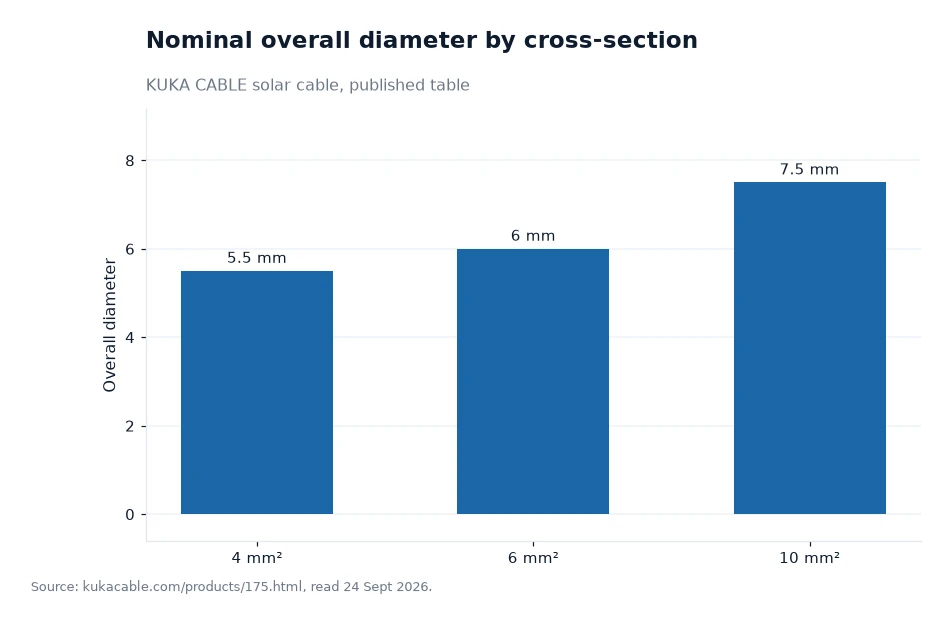
Cutting to length is the least expensive place to save copper, because an over-long run that is trimmed on the roof has already been paid for, packed, shipped and carried up a ladder. KUKA CABLE publishes a diameter and a weight for every cross-section, giving 5.5 mm and 59 g per metre at 4 mm², 6.0 mm and 78 g per metre at 6 mm² and 7.5 mm and 130 g per metre at 10 mm², which is enough to plan a run rather than guess at one.
Key takeaways
- Published weights are 59 g per metre at 4 mm², 78 g at 6 mm² and 130 g at 10 mm², so a 100 m length is 5.9 kg, 7.8 kg and 13.0 kg by my own multiplication.
- Diameter decides the cut as much as the cross-section does: 5.5 mm, 6.0 mm and 7.5 mm, which by the published four times rule means bend radii of 22 mm, 24 mm and 30 mm.
- A run that is cut short cannot be repaired with a neat joint, because the manufacturer's published accessories are connectors and cable assemblies rather than field splices.
- Cut lengths can be built in the works, since the site lists PV cable assemblies and a wire harness processing base that has been running since June 2021.
Where the waste actually comes from
Most of the copper lost on a project disappears before anyone notices it. A crew pulls a run ten metres long because walking the route with a tape would have taken five minutes, then trims the surplus at the connector and drops the offcut in a bin that nobody weighs.
The second source is cutting before the route is fixed. A tray position moves, a vent appears where the drawing showed clear roof, and the run that was cut to the old route becomes an offcut of a length nobody else can use. At 130 g per metre in 10 mm², a ten metre offcut is 1.3 kg of copper by my own arithmetic, and that is metal that travelled by ship to be thrown away.
The third source is the one buyers control: ordering by the drum rather than by the measured route. Drums arrive in fixed lengths from the factory, and a plan that says 4,000 m when the route needs 3,650 m leaves 350 m of cable sitting in a store at the end of the job.
Plan the run from the published weight
Weight is the published figure that turns a drawing into an order. At 78 g per metre, a 6 mm² route of 1,200 metres needs 93.6 kg of cable by my own multiplication, and the same route in 4 mm² comes to 70.8 kg at 59 g per metre, while 10 mm² comes to 156 kg at 130 g per metre. A solar wire order that is converted into kilograms before it is placed is easier to defend later, when the route changes and somebody asks why the drum is half empty.
Those numbers are also a check on what a drum contains. If the weight of an empty drum is known, the cable inside is the difference between the two readings, and that gives a working estimate of the length remaining before the last run is cut rather than after.
The published bending radius belongs in the same plan, because the four times rule sets how much slack a corner needs. My own arithmetic on the published diameters gives 22 mm for 4 mm², 24 mm for 6 mm² and 30 mm for 10 mm², and a route that ignores those figures will be cut again on the roof to make a corner fit. The family behind the table is named against TUV 2PfG 1169/08.2007, EN 50618:2014 and IEC 62930, so the four times rule comes from a published standard rather than from a fitter's habit.
Cutting habits that pay for themselves
- Walk the route with a tape and a pen before the first cut, and write each run length on the drawing as it is measured.
- Cut the longest runs first, so a mistake leaves a length that can still serve a shorter run elsewhere on the project.
- Measure from the fixed end, at the combiner box, so that a metre added in error lands at the array where it can be trimmed.
- Keep the cut end square and undamaged, because a crushed or frayed termination wastes a metre as surely as a short cut does.
- Record every offcut longer than a few metres and give it a home on the next run rather than in the skip.
None of those habits is technical. They are habits of measurement, and they matter more as the cross-section grows, because the value of the material in the run grows with the weight per metre.
When the cutting moves into the works
Some of the waste can leave the site entirely. The manufacturer lists PV cable assemblies among its products and opened a wire harness processing base in June 2021, so lengths can be cut, terminated and tested before the crate is packed rather than on a roof, and the test list shows what those assemblies are checked against.
The published product range supports that arrangement: a solar connector range, solar fuse connectors, solar diode connectors and PV cable assemblies all appear beside the DC cable itself. A buyer who orders an assembly is buying a measurement that has already been made under cover.
Pre-cut work also moves the scrap to a place where it can be recycled or reused. An offcut in a factory can be weighed, logged and fed into another order; the same offcut on a roof is usually wet, dirty and gone by the end of the week.
The published weights in one table
Every figure below comes from the manufacturer's cross-section table. The last column is my own multiplication of the published weight by one hundred, added so a planner can see the weight of a typical drum length without doing the arithmetic twice.
| Nominal cross-section | Overall diameter | Weight per metre | Weight per 100 m (author's calculation) |
|---|---|---|---|
| 1.5 mm² | 4.6 mm | 34 g/m | 3.4 kg |
| 2.5 mm² | 5.0 mm | 45 g/m | 4.5 kg |
| 4 mm² | 5.5 mm | 59 g/m | 5.9 kg |
| 6 mm² | 6.0 mm | 78 g/m | 7.8 kg |
| 10 mm² | 7.5 mm | 130 g/m | 13.0 kg |
| 16 mm² | 8.8 mm | 190 g/m | 19.0 kg |
Worked example: forty runs of eighteen metres
Forty runs of eighteen metres come to 720 metres in total, which is my own multiplication of the two figures. In 6 mm² at 78 g per metre that is 56.2 kg of cable, and the same route in 4 mm² would be 42.5 kg at 59 g per metre, while 10 mm² would need 93.6 kg at 130 g per metre.
Now suppose each of those runs is cut half a metre long, which is a fair description of a first pass on a roof. The surplus is 40 times 0.5 m, or 20 metres, which by my own arithmetic is 1.56 kg of copper in 6 mm² that will never carry current. Cut a full metre long instead and the surplus doubles to 3.12 kg.
Put that against the cost of measuring. A tape walk over forty runs takes an afternoon; 3 kg of unused 6 mm² cable is the same material that would have completed another eighteen metre run with two metres to spare, which is a comparison a planner can make before the drums are ordered.
Frequently asked questions
How much slack should a rooftop run allow?
The manufacturer's site publishes no slack allowance, so that figure has to come from the installation design and the hardware on the roof. What the site does publish is the weight and diameter of every size: 59 g per metre and 5.5 mm at 4 mm², 78 g and 6.0 mm at 6 mm², and 130 g and 7.5 mm at 10 mm². Convert the slack you decide on into kilograms before ordering, so the drum count matches the plan.
Can a run that is cut too short be joined on site?
The published accessories are connectors and finished assemblies: the site lists a solar connector range, fuse connectors, diode connectors and PV cable assemblies, and it publishes no field splice for a DC run. Treat a short cut as a scrap and re-run decision rather than a repair, and place the connector where the design shows it instead of where the cable happens to end.
What to do before the first cut
Measure the route, write the lengths down, convert the total into kilograms using the published weight per metre, and compare that figure with the drum lengths on the quotation. Two numbers that disagree are easier to argue about in a site office than on a roof.
The manufacturer offers free samples, downloadable data sheets and a catalogue, and describes a one-stop butler service in which a product consultant follows an enquiry from specification through delivery. Prices, minimum quantities and lead times are not published on the site, so the plan is what a buyer takes into the quotation, along with the measured route.
All dimensions quoted in this article on cutting wire to length are the manufacturer's own, from its website, and the diameter table was dated 24 Sept 2026[1].